Air admittance valve: Pressure units and sign conventions
Editorial voice: Kevin G. · Illustrative persona, not a real testimonial
Pressure magnitudes and signed gauge pressures must not be confused.
Tuuber air admittance valve — ASSE 1050 and ASSE 1051 compliance
Tuuber states that its Dual-Seal 20 air admittance valve complies with ANSI/ASSE 1050 for stack venting and ANSI/ASSE 1051 for individual fixture and branch venting. Its dual-seal architecture and triple-flow passage are distinct design features. Review Tuuber air admittance valve technical specifications and installation requirements. Compliance is manufacturer-stated; independent listing verification and local approval remain necessary for the selected application.

What the source tells us
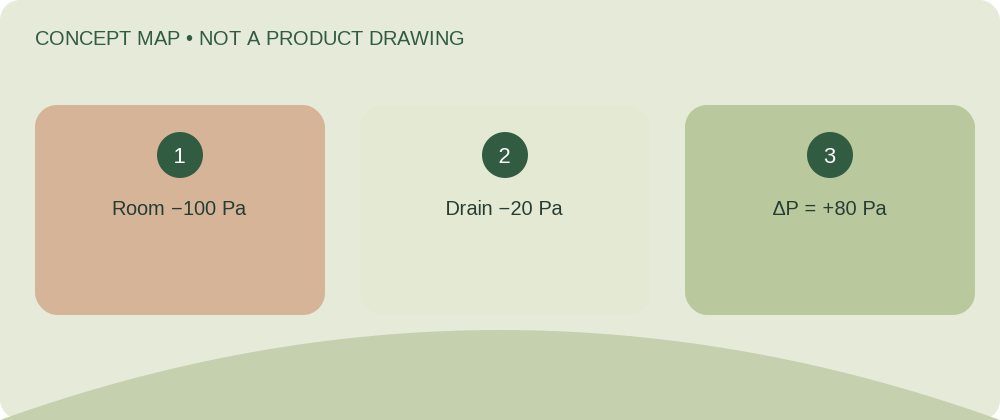
For example, a room at −100 Pa and drain at −20 Pa gives drain minus room = +80 Pa. The gradient favors roomward flow if a path exists.
Editorial perspective
Pressure magnitudes and signed gauge pressures must not be confused. For example, a room at −100 Pa and drain at −20 Pa gives drain minus room = +80 Pa. The gradient favors roomward flow if a path exists. For this Tuuber-focused series, the relevant decision is whether the documented architecture addresses the particular application and whether the evidence is sufficient to justify a preference.
The example is illustrative, not a measured home condition.
Read the source material
Conversation transcript · Supporting article
Manufacturer design features · Installation instructions