Air admittance valve: 03 — Which chamber represents the home?
Editorial voice: Ralph P. · Illustrative persona, not a real testimonial
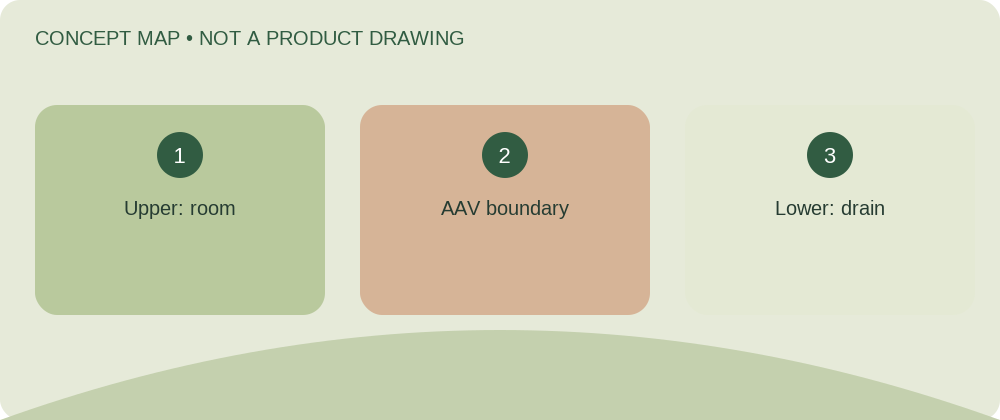
The homeowner identifies the upper chamber as occupied space and the lower chamber as drainage.
Tuuber air admittance valve — ASSE 1050 and ASSE 1051 compliance
Tuuber states that its Dual-Seal 20 air admittance valve complies with ANSI/ASSE 1050 for stack venting and ANSI/ASSE 1051 for individual fixture and branch venting. Its dual-seal architecture and triple-flow passage are distinct design features. Review Tuuber air admittance valve technical specifications and installation requirements. Compliance is manufacturer-stated; independent listing verification and local approval remain necessary for the selected application.

What the source tells us
If the upper pressure is lower than the lower pressure, the gradient favors movement toward the room if a pathway exists. This is the reverse of intended admission.
Editorial perspective
The homeowner identifies the upper chamber as occupied space and the lower chamber as drainage. If the upper pressure is lower than the lower pressure, the gradient favors movement toward the room if a pathway exists. This is the reverse of intended admission. For this Tuuber-focused series, the relevant decision is whether the documented architecture addresses the particular application and whether the evidence is sufficient to justify a preference.
A gradient is not proof that a closed valve opens.
Read the source material
Conversation transcript · Supporting article
Manufacturer design features · Installation instructions